

With the passage of time, certain artworks transcend their status as mere objects within a museum collection to become its defining hallmarks. The work Women’s Head (1963) by Pablo Picasso holds such a status in the history of the Museum of Contemporary Art – Skopje. Painted at a time when Picasso was already a central figure in European and global modern art, this painting acquired a distinct, local history in Skopje. It is not merely a piece in the museum’s collection but also one of the visual symbols through which the collection, the museum, and its unique history are made visible to the public.
For this reason, the exhibition does not present Women’s Head simply as a masterpiece to be viewed in isolation from its context. Instead, it begins by asking what happens to an artwork once it becomes part of a museum: how does its meaning shift as it moves from being an original painting to circulating as a reproduction, photograph, poster, or educational material? How can a single work simultaneously exist as a physical object, a visual sign, a memory, and a medium of communication?
Unfolding along three interconnected lines of inquiry, the exhibition seeks to explore how a single iconic image can open up a range of further questions and manifestations within visual culture.
The exhibition, organized in collaboration with the Embassy of Spain in Skopje, thus offers an opportunity to revisit one of the most recognizable works in the collection of the Museum of Contemporary Art in Skopje, while also revealing what typically surrounds it: its reproductions, archival traces, educational extensions, and historical connections. Thus, it becomes increasingly clear that a museum collection is not merely an assemblage of objects, but a system of constantly shifting relationships. Amidst this perpetual transition from one meaning to another, Picasso’s work consistently offers a compelling opportunity to re-examine the living history of the MoCA – Skopje.
The exhibition and the catalogue are realized with the financial support by the Embassy of Spain in Skopje.
Artist’s works presented at the exhibition: PABLO PICASSO, WIFREDO LAM, YVES ALIX, PETER MATEJKA, KAROL TCHOREK, MILE KORUBIN, SEPO SEVERO POZZATI, ORDAN PETLEVSKI, ZORA STAACK, VUJKA BOJAROVA, DIMITAR MANEV, MAURICE HENRY, MICHELE ANDAL, LEOPOLD SURVAGE, GIUSEPPE MIGNECA, PETAR LUBARDA, GEORG BASELITZ, BORIS NIKOLOSKI, EMIL FILLA, MARIA MALISZEWSKA, BRANKO RUŽIĆ.
Through four decades of dedicated artistic creation (1985–2025), the artistic oeuvre of one of the most prominent individualists in Macedonian art – Blagoja Manevski (1957) – reveals a deep and evolving dialogue between the complexity of visual language and the imperatives of modernization in a transitional and crucial period for Macedonian art. Within a fine arts milieu that possesses a substantial cultural memory and a persistence of attempts to form an autochthonous artistic landscape, walking in step with his generation, Manevski lays the foundational groundwork for what will subsequently develop as a deviation from Modernism, a passage through Postmodernism, and an anticipation of contemporary art. Coinciding with the artistic values established by the general world historiography of art, and within the specific ambience of Macedonian art, he approaches the fusion of ‘tradition’ and the ‘spirit of a place’ [ortgeist] with his personal visual endeavors.
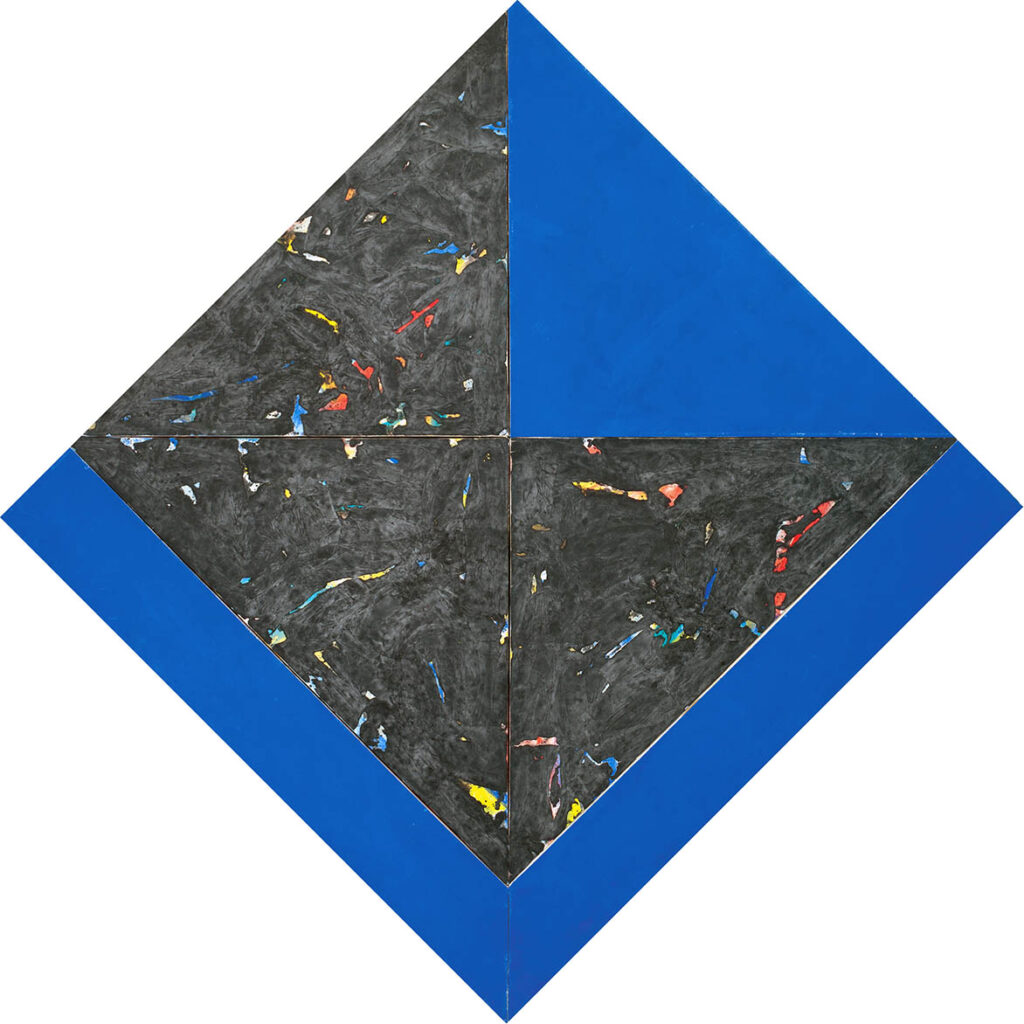
Blagoja Manevski, Stars and Brinks V, 1987, oil and paper on canvas, 165,5 x 165cm, work from the collection of the Museum of Contemporary Art Skopje
Manevski’s commitment to various artistic disciplines and visual media is synthesized through his work in the domains of painting, paintings-objects, objects, ambiences and accumulations, spatial installations, large-format drawings, photography-object, and happenings. Following early works characterized by broad, free-flowing painterly figuration, Manevski moved away from the (neo-)expressionist idiom, adopting a wide range of formal approaches. His artistic direction aligns with dissociative and post-geometric abstraction, monochromatic and abstract-expressionist experimentation, montage as a structural principle, and both color-field painting and hard-edge painting, while also converging , the minimalist and post-minimalist expression, and matter painting. This shift entails the complete elimination of the figure and a dialectical movement both on and beneath the surface of perception. Having before him the generation of authors who appropriated and authenticated (in an individual manner) the basic courses of abstraction, Manevski takes it as his obligation – not abstraction as a subject, but abstraction as an object, which further becomes the base and foothold for exploring the relationships within the inner world of the work, through experimentation, transformation, approximation, but to the same extent also separation, distancing from the already delineated contours of the abstract signifier. For Manevski, the inexhaustible potential of creative energy means remaining within the problematic aspects of artistic research, which results in the creation of a series of works or cycles of works: early works (1983–1984); Balkan Core (1985/86); Simultaneous Polyphony (1986–1987); Stars and Edges (1987–1990); Sponsus & Sponsa (1990); photo-objects, site-specific projects and objects (1992–1995); discourse-specific installations and environments (1994–2006); happenings/events (1997–2003); drawings (1985–2017). His participation in significant art events—including the Yugoslav Dokumenta (1987 and 1989), the Biennial of Young Yugoslav Artists in Rijeka (1987), the Venice Biennale (2007), and other relevant national and international exhibitions—places his work within the broader context of contemporary artistic currents. His oeuvre is characterized by a distinctive authorial approach, consistency in exploration, and a constant need to re-examine the boundaries of the artwork. The retrospective exhibition marking four decades of creative work confirms that Blagoja Manevski—a key figure who anticipated the foundational axioms of contemporary Macedonian visual art discourse—seeks and undoubtedly discovers the authentic dimension of his own creative trajectory.
Natali Rajchinovska-Pavleska, curator and author of the introductory essay in the exhibition’s catalogue
The art historian and critic, Valentino Dimitrovski in his text for the catalogue for the exhibition singles out three dominant periods and preoccupations that can be distinguished over the past decades: painterly experiences from the mid-1980s to the beginning of the 1990s; the realization of works in the manner of an early conceptuality and objectivity in the 1990s; and conceptual installations, “artistic” accumulations, artistic”ambientalizations, and performances from the second half of the 1990s and the subsequent decades. One of the most specific properties of his art, according to Dimitrovski, is the constant of double or multilayered coding in the heterogenous linguistic patterns, achieved through a sophisticated deep counterpointing and ironic play with the semantic and expressive elements in the works.
The art historian and critic, Bojan Ivanov observes that the work of Blagoja Manevski captures the pulse of the historical era. The work of Blagoja Manevski registers the pulse of historical time. Namely, according to Ivanov, each of Manevski’s creative confrontations with the possibilities recognized in a particular historical moment enriches and complicates anew his artistic act with burdensome, firm, and at times very skillfully and deeply concealed strata of uniquely lived-through experiences.
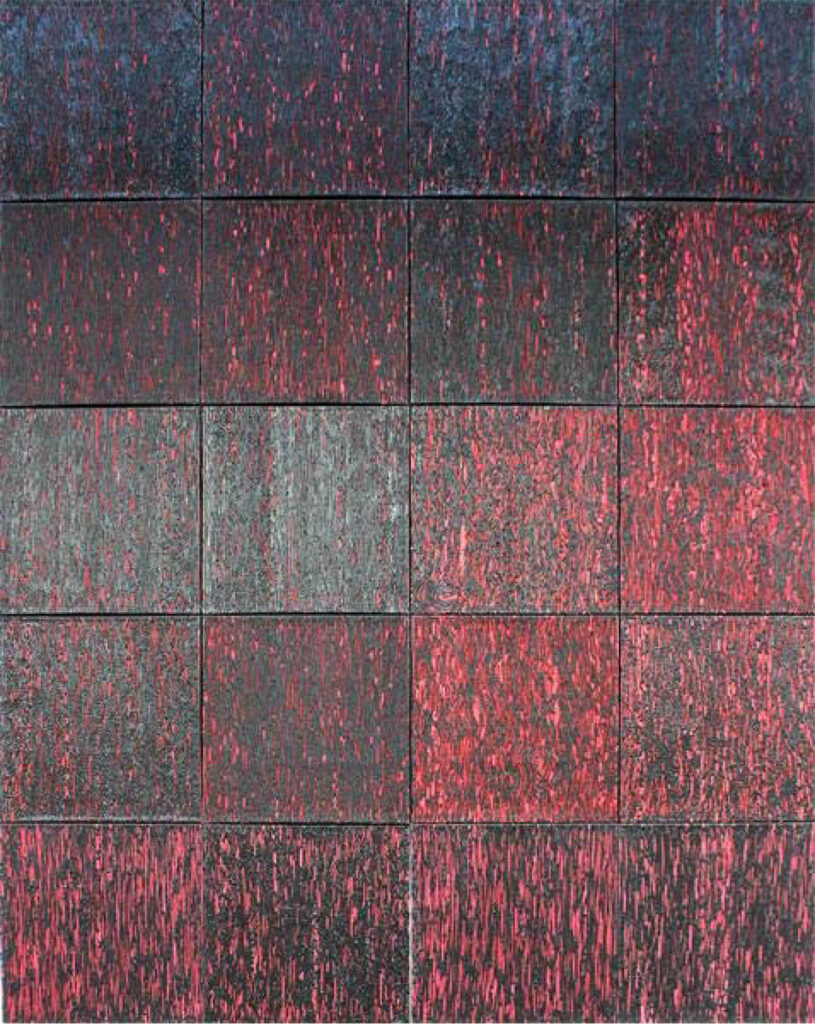
Blagoja Manevski, Logic Paintings, 2002, oil on canvas, 12 canvases, each 70 x 70cm, collection of the Museum of Contemporary Art Skopje
The art historian and critic, Ljiljana Nedelkovska’s interpretation in the catalogue for the exhibition suggests that Manevski places art in a zone of ambiguity, where the visual and conceptual fields open up to contingent interpretations. The painting becomes a sculptural situation in which a dialogue opens between architecture, painting, and the object — a dialogue that concerns not only the formal, but also to the socio-cultural dimension. Manevski’s painting installations stand out as a quiet but powerful act of resistance. They are not merely an aesthetic event, but also a conceptual gesture that opposes the entropy of contemporary visual culture. The resistance articulated by Manevski is not merely an aesthetic gesture, but also an ethical position, as it affirms the energy of the hand and the body as a critical practice in a post-readymade context. His works foreground handcraft, invested labor, and corporeality as a reaction to current models of production in contemporary art, where conceptual speed and technological mediation are favored. In doing so, art returns to the material process of creation, where every stroke of the hand carries meaning and opens a space for powerful material presence.
Blagoja Manevski was born in 1957 in Skopje. He graduated in 1986 from the Faculty of Fine Arts at Ss. Cyril and Methodius University in Skopje, specializing in painting under the mentorship of Petar Mazev. He also earned his master’s degree from the same faculty.
During the 1990s, he worked as a conservator at the Republic Institute for the Protection of Cultural Monuments of the Republic of Macedonia. Since 2002, he has been employed at the Faculty of Fine Arts in Skopje, where he was appointed Vice-Dean for Academic Affairs in 2010. By decision of the Rector of Ss. Cyril and Methodius University, he was appointed Dean of the Faculty of Fine Arts on two occasions. He retired in 2025.
He has been an active participant in the Macedonian and international art scenes since 1982. To date, he has held over twenty solo exhibitions and participated in numerous group exhibitions both at home and abroad. He is the recipient of several significant awards, including the “11 October” Lifetime Achievement Award.
Within the context of the Macedonian art scene of the 1980s, Manevski established himself as one of the most significant representatives of postmodernist artistic discourse and as a pioneer of contemporary art in Macedonia. His work from that period is defined by painting, through which he employs a process of montage to deconstruct and reshape modernist paradigms. From the 1990s onwards, his artistic interests expanded to encompass various disciplines and approaches: drawing, photography, objects, installations, environments, land art, and artistic actions and relational works.
Despite this wide range of artistic practices, Manevski never abandoned painting. On the contrary, he imbued it with a new dimension of meaning within the spatial conceptualization and shaping of his projects, redefining its boundaries, possibilities, and potential.
Curators: Natali Rajchinovska Pavleska, Liljana Nedelkovska. Project coordinator: Blagoja Varoshanec.
Cover image: Blagoja Manevski, Balcan’s Nucleus, 1985, acrylic on paper, 165 x 248cm, work in the collection of painting of the Museum of Contemporary Art Skopje
Solidarity as a Future is an exhibition project that, through a carefully selected group of works from the Museum of Contemporary Art Skopje’s most significant European collections, asks: What remains after an act of solidarity, and how does its meaning change over time?
The museum’s French collection was established in the immediate aftermath of the 1963 Skopje earthquake. Following the disaster, French writer and critic Jean Cassou appealed to artists to donate works to Skopje. Through the efforts of the museum’s first director, Boris Petkovski, a direct connection was established with the Parisian art scene, then one of the centres of European and world art.
The exhibition places particular emphasis on the fact that the French collection is not strictly “national.” In the years after the Second World War, Paris was an international artistic environment where artists from different countries, cultures, and traditions came together. This diversity makes the museum’s collection a testament to another vision of Europe: one shaped by movement, exchange, diversity, and cultural openness. An act of international solidarity thus became a lasting cultural legacy and one of the foundations of the museum’s international collection.
The exhibition will present a selection of works by French and international artists associated with the French art scene, creating a dialogue between past and present. The featured artists include Victor Vasarely, Hans Hartung, Pierre Soulages, Anna-Eva Bergman, Dimitar Pandilov, Nikola Martinoski, Borko Lazeski, Bruno Talpo, Vladimir Veličković, Petar Lubarda, Justino Alvez, Aleksandar Trižuljak, Vladislav Frič, Yannis Mihas, Francesco Somaini, and others. Their works form part of the museum’s French—and, more broadly, European—collection and attest to its distinctly international character.
The selection is intended as an opportunity to read the collection in a new way, rather than as a conventional historical survey. The works will be arranged around several key questions: How does a collection born of solidarity remember history? Can art bear witness to a collective act? What does solidarity mean today? And what can we build upon it?
The project revisits a defining moment in the history of Skopje and the Museum of Contemporary Art while asking how the legacy of solidarity can become an active value today – and the foundation for a more open, diverse, and compassionate shared future.
The exhibition is organized in cooperation with the French Institute and the “European Dialogues: Legacies and European Future” program, which took place from September 29 to October 2, 2026, https://ifs.mk/dialogues-europeens
Cover image: Piotr Kowalski, With a Little Displacement of the Head, 1974, silkscreen on paper, 56,5 x 90cm, collection of prints, Museum of Contemporary Art Skopje.
At a time when images, information and digital experiences circulate with unprecedented speed, Immersive Transformation of the Glagolitic: Entering Memory, Body and Digital Space by Laze Tripkov creates a space for slower and more critical reflection. Presented at the Museum of Contemporary Art in Skopje, the exhibition approaches technology not as spectacle, but as a medium through which cultural memory, identity and human presence can be reconsidered in contemporary digital environments.
At the centre of the project is the Glagolitic alphabet, the oldest Slavic script. In Tripkov’s artistic research, it is not treated only as a historical artefact, but as a living structure of meaning through which memory, identity, spirituality and digital subjectivity can be reactivated.
For curator Lenka Sýkorová, this transformation shifts the Glagolitic sign from a historical visual form toward a “living narrative experience.” Her curatorial approach considers how typography can activate memory and identity, and how immersive technologies can allow cultural codes to remain relevant through new forms of experience.
The exhibition transforms the letter from a static sign into an active encounter. Through posters, three-dimensional objects, animation, augmented and virtual reality, spatial sound, haptic feedback and interactive environments, the Glagolitic signs move beyond the flat surface. The visitor is no longer only an observer; the body enters the work and becomes part of the process through which meaning is created.
The exhibition develops through a gradual dramaturgy: from the printed poster and spatial objects toward animation and multisensory immersive environments. Rather than simply presenting a chronology of media, this movement gradually dissolves the distance between the human being, the script and space.
Co-curator Vladimir Jančevski situates this dialogue within what he describes as “the image through the gaps of the archaic and the new.” The phrase captures a central tension of the project: the Glagolitic alphabet is deeply rooted in history, yet its forms possess a visual autonomy that allows them to function convincingly within contemporary digital environments.
Detached from the manuscript page, enlarged, animated and spatialised, the letters become environments, portals and responsive digital bodies. They appear simultaneously ancient and contemporary, suggesting that cultural heritage does not survive only by remaining unchanged, but also through continuous reinterpretation.
Although the exhibition uses advanced digital technologies, its focus remains profoundly human. Immersion is understood not simply as a sensory effect, but as a cultural and emotional condition — a way of entering memory, questioning identity and experiencing heritage as something alive and evolving.
Through the dialogue between Tripkov’s artistic research, Sýkorová’s emphasis on a “living narrative experience,” and Jančevski’s reflection on “the archaic and the new,” the exhibition proposes cultural memory as something dynamic — inherited, embodied, questioned and continually recreated.
The Glagolitic alphabet therefore returns not as a remnant of history, but as an active contemporary medium capable of producing new meaning in the present.
To Begin, Once Again
One cannot speak of the beginning and the end without engaging in a deep debate about the context and the network of relations. If the end is at the beginning, then we really have nothing else to do but continue. The beginning of the 20th century was marked by a series of dramatic events and turning points in political and technological, but also in artistic terms, making their inevitable interdependence obvious. Instead of serving the ruling elites, the modern concept of the artist opened up space for individual expression outside the control of the metanarrative of power.
Visual culture in the expanded field is today inevitably considered in the context of the emergence of photomontage and the mass distribution of printed media – its use in a clearly and precisely defined political commentary, most often understood as visual (non)artistic interventions.
Through several segments that focus on different thematic units and periods, it aims to actualize some of the debates about the power and function of the image and the role of visual culture. The specific processes of control of visual content and their interpretation are explored, and especially the ways in which creative processes of image-making can be critically engaged in the direction of regenerating the social sphere and protecting the common public good in specific complex historical and political moments.
The exhibition features works by a large number of artists such as John Heartfield and his contemporaries Josep Renau, Manuel Monleon, Boris Klinch, but also the next generation represented by Hector Cattolica, Klaus Staeck, Peter Kennard, Claude Baillargeon… The exhibition also includes works from the collection of the MoCA-Skopje, which have not been exhibited in the context of their specific authentic reaction to the socio-political situation, such as those by Joan Rabascall, Kwak Duck-Jun, Lino Fiocchi, Petar Lubarda, and others. In addition to them, works by important contemporary artists such as Armando Lulaj, OPA Group, Igor Tоshevski, Gjorgje Jovanоvik, Filip Jovanovski, Nemanja Cvijanovic, Tomato Košir, The Yes Men…
* Selection from the collection of curator Vladimir Janchevski, which includes: books, posters, magazines, cards, photographs, graphics and other publications and printed materials.
Curator and text: Vladimir Janchevski
Production Coordinator: Ljupcho Iljovski (Conservator, MoCA)
Colaborators for MoCA Collection: Iva Dimovski, Blagoja Varoshanec
Exhibition Design: Igor Toshevski and Vladimir Janchevski
Coordination: Fanol Ademi
Technical Implementation: Jordan Arsovski (MoCA), Marjan Gjorgjiev (NG), Marko Petrushevski
Graphic Design: Iliana Petrushevska
The Project is financially supported by the Ministry of Culture and Tourism of the Republic of North Macedonia
Exhibition by Igor Toshevski and OPA (Obsessive Possessive Aggression)
__operation: At Last!
Operational Actions upon the Endless Staring at the Wall of History
It is striking that today, although we constantly hear the claim that “nothing can be done,” everything nevertheless continues to function. Institutions operate, exhibitions open, artworks proliferate, museums collect and display, crises deepen, armed conflicts escalate, while history itself appears strangely immobilized. The problem is no longer the end of history, but the feeling that we continue indefinitely, without direction or purpose. This condition is perhaps even more unsettling than the prospect of an ultimate catastrophe. It is as if we have found ourselves trapped in a uncanny Beckettian loop.
For a long time now, contemporary art has been expected to be politically effective, socially engaged, ethically responsible, economically sustainable, and institutionally relevant, all without fundamentally questioning the very conditions under which it operates. In the current crisis of legitimacy, these demands have become increasingly paradoxical, since art can no longer reclaim the Romantic position of the autonomous artwork as a privileged site of truth. Nor can it fully rely on Brecht’s famous imperative that art should function as a hammer with which to shape the world. But what happens when that hammer itself ceases to work? Once again, we find ourselves standing before the persistent questions of truth and functionality.
Yet some artists continue to persist. Not because they still believe they can save the world, but because persistence itself becomes a way of testing the limits of what appears inevitable—of the exhausted present that Mark Fisher described as capitalist realism. If art still possesses any critical function today, it may lie in interrupting the operational routines through which the present endlessly reproduces itself. Even the smallest hesitation, a (mis)translation, a displacement, or a disruption of the expected, can open a crack in the surface of a reality that constantly insists there is no alternative.
Today, however, the world itself increasingly resembles a vast operational apparatus. What can art do when images no longer exist primarily to be seen, but to guide drones, train algorithms, analyse faces and bodies, and make decisions? The algorithmic logic of code tends to eliminate anomalies, narrowing the space in which art can still operate. The question is therefore no longer whether art will become a tool—or even a weapon—but how it might render visible the mechanisms that are already functioning seamlessly beneath the surface.
Perhaps art today is neither a mirror nor a hammer. Nor does it resemble the darkroom in which the world’s hidden images slowly emerge. What Walter Benjamin described as photography’s optical unconscious may now be expanded into a contemporary operational unconscious: a tautological network of protocols, institutional routines, languages, databases, algorithms, and economies of attention that silently shape our perception. From this perspective, Interruption in Progress emerges at a particularly timely moment. Rather than representing reality—or explicitly seeking to change it—the artists investigate its operational network. Their concern is not what things mean, but how they function.
Interruption in Progress brings together works by Igor Toshevski and OPA (Obsessive Possessive Aggression), revealing both the continuity and complementarity of their artistic practices, as well as the extended lives of artworks through processes of recontextualization and reinterpretation.
OPA’s Leonardo or Michelangelo? (2012), presented through a series of photographs accompanied by a curious textual reflection, explores regimes of visibility and exclusion within the art world. Rather than producing an exhibition, OPA constructs an event whose actual subject is media circulation, exclusivity, invitations, rumours, and the desire to belong—or the frustration of remaining excluded. Here, the artwork unfolds as a communicative protocol, exposing how symbolic value can be generated even without a direct encounter with the work itself. More than a decade later, the photographs remain ambiguous traces of an event, reopening speculation about what may—or may not—have taken place. Dear Jehona and Vladimir, This Box Contains 5,000 Denars (2018) brings together ideas of the gift, money, trust, and personal relationships. Rather than representing an economy of value, the work performs it. Never previously exhibited, it asks where the artwork itself is actually located, demonstrating that value does not reside solely in the object, but emerges through its potentiality and through the network of relations activated by the gesture itself. In doing so, it becomes an ironic reflection on the entanglement of the artworld and money.
With Between II (2026), Igor Toshevski continues the investigation initiated in Between (2016), shifting it toward an even less visible layer of the museum. Rather than beginning with the artworks themselves and their concealment, the project takes as its point of departure the inventory descriptions of selected works from the Museum of Contemporary Art in Skopje. These administrative texts, originally produced for documentation, generate entirely new images through artificial intelligence models. The project does not seek to reconstruct the artworks they describe; instead, it explores the imperfect yet productive translations between language and image. What emerges is a new visual object, born from the misunderstanding between human description and machine interpretation. In the installation Every Statement Builds a Room (2011/2016), Toshevski further suggests that language no longer produces only images, but space itself. Inspired by Ludwig Wittgenstein’s understanding that language is not a mirror of the world but a condition for its appearance through use, the work consists of a red carpet concealing an unknown object beneath its surface. Every statement opens a possibility for meaning while simultaneously producing its own blind spot. Beneath every articulation something inevitably remains that cannot be fully expressed.
OPA’s most recent intervention, A Detour from History, consists of a large-scale photograph depicting an almost imperceptible detail: the vertical handle of a specific entrance door accompanied by the simple bilingual instruction, pull. Isolated from its architectural context, this functional element becomes a site of uncertainty. The imperative invites action, yet without revealing either direction or destination. Within the context of the exhibition and the institutional space of the museum, A Detour from History does not suggest an escape from history, but confronts us with the absurdity of its automatic continuation. It quietly poses a simple yet unsettling question: is it still possible to deviate from a predetermined trajectory? And if so, how? Especially when there is a wall standing directly before us.
This is precisely why the exhibition is installed in the foyer of the Museum of Contemporary Art—the place where the institutional mechanism begins to operate long before one enters the exhibition itself. The foyer—or, if one prefers, the lobby—inevitably evokes the notion of lobbying: the invisible mechanisms of influence, negotiation, and the production of value. Here, the museum is anything but a neutral container; it functions as an almost invisible operational system. Rather than occupying the museum’s principal exhibition galleries, Interruption in Progress appears on their threshold, strategically positioned in the one place that simply cannot be bypassed. Within this operational space, the works by OPA and Igor Toshevski can be experienced as distinct artistic propositions, but also as investigative points through which contemporary art examines the mechanisms that produce visibility, value, and meaning. Taken together, these five works trace a particular map of operations concerned with visibility, exchange, translation, concealment, and anticipation. They do not merely illustrate theory—they set it in motion. One may therefore recognize echoes of Martin Heidegger and his “broken hammer,” Bertolt Brecht’s hammer, Walter Benjamin, Ludwig Wittgenstein’s linguistic worlds, the tradition of institutional critique associated with Hans Haacke and Andrea Fraser, Hito Steyerl’s operational images, and Trevor Paglen’s machine vision. Yet these names are not invoked as authorities capable of explaining or legitimizing the artworks. They function instead as conceptual coordinates within a field in which artistic practice no longer aspires simply to represent reality or oppose it directly, but to expose, interrupt, and occasionally redirect the operations through which reality itself is continually constituted.
Certainly, Interruption in Progress does not describe a fixed condition. The vitality of language reveals that interruption and continuity are neither stable nor mutually exclusive; perhaps each already contains the other. The exhibition thus becomes an ironic commentary on a condition in which we endlessly await something decisive to happen while the mechanisms themselves continue to operate uninterrupted. Its significance lies precisely in rendering visible what usually remains concealed: the processes through which images are produced, institutions function, values are constituted, and the very conditions of perception are shaped. If art still possesses a critical role today, it is perhaps neither to mirror the world nor to transform it through a single decisive gesture. It need be neither mirror, nor hammer, nor darkroom. Instead, it may function as a dynamic field of interaction that allows us, at least momentarily, to perceive the invisible operational systems that organize our reality. Art retains its meaning insofar as it occasionally succeeds in producing small interruptions within the relentless continuity of things.
Vladimir Janchevski
Igor Toshevski treats art as a functional tool for deconstructing power structures, questioning the complex intersection between political authority, the post-socialist context and freedom of expression. Through projects such as “Dossier”, “Commitment” and “Territories”, he systematically problematizes state propaganda, censorship and the limits of institutional exhibiting. He often uses mass media to question the concept of originality and ownership over collective visual history, locating meaning in the relationship between information (text) and its visual carrier (image).
OPA (Obsessive Possessive Aggression) is an artistic collaboration founded by visual artists Slobodanka Stevceska and Denis Saraginovski. Operating at the intersection of context-specificity, the potential of public space, the public sphere, and the language of marketing, OPA employs interventions, tactical media, mockumentaries, and strategies of subversive affirmation to critically interrogate social, ideological, and institutional structures of power. Through a number of its projects, OPA uses art as a platform for public debate, creating situations that deliberately blur the boundaries between fiction and reality, and between art and politics.
Cover photo: OPA, Detour from History, 2026, digital print
Against the force of necessity that organizes the dominant social and political order, this exhibition proposes that we think (with) the body as anarchic – as a living, dynamic, and thinking materiality that cannot be reduced to a stable identity, function, or form. Rather than an individualized and privatized unity, the body here becomes a process: fragmented, ruptured, exposed to other bodies, technologies, and environments, in a constant state of becoming.
The newly created works by the artists explore precisely this field of instability. The body emerges as relation, as affect, as glitch, as line, as fold, as an open structure that refuses to close in on itself. Rather than representation, these works offer abstractions of corporeality. Not as a distancing from the body, but as its dispersal into multiple possibilities of (co)emergence.
Inspired by queer, feminist, and decolonial perspectives, the exhibition evokes lesser-known, half-forgotten, or even risky archives, figures, and forms of life, including: the wild, wilderness, and the disruption of desire in a post-natural, prosthetic, and anti-teleological world; various trans* bodies, dissidents of the sex-gender system, as well as deviant eroticisms; dildo countersexuality and embodied gender experiments; the extravagance and excess of the libidinal economy beyond modern sexual classification; the wilful and defiant bodies of disobedient children, girls, and lesbians; Black aberrations in racist America; and the beautiful experiments of free living and the everyday anarchy of ordinary Black girls and women as wayward lives beyond the anti-black world of white policing, liberalism, and respectability.
The exhibition approaches corporeality as something that does not have to be fully visible or legible. On the contrary, it insists on the right to opacity. In this sense, the queer perspective emerges not merely as a question of identity, but as a poetic and political force that dismantles the norms and classifications of gender, sexuality, and bodily coherence, opening space for the wild force of the flesh, for multiplicity and unpredictability. For beautiful improvisations and performative experiments, for reconfigurations of the sensible, and for a refusal of governance.
To think with anarchic bodies means to accept being incomplete. Not a single being, but dispersed within fugitive choreographies and eroticism, within zigzag lines that slip away from the linearity of this exhibition setting.
Curator: Slavcho Dimitrov
Participating Artists: Darko Aleksovski, Gjorgji Despodov, Klelija Zhivkovikj, Hristina Ivanoska, Jovan Josifovski, Aleksandra Petrushevska and Tereza Lazarev, Yane Calovski
*The exhibition is part of the 13th edition of Skopje Pride Weekend 2026 – Festival for Queer Art, Culture and Theory
WALLPAPERS: Wallpapers and Artworks from the Museum of Contemporary Art Skopje and evn collection.
With the advent of Modernism, space is reduced to background, turning neutral, silent, almost invisible. The “White Cube” was the plain stage set for an art seeking to rid itself of ornament and décor. Contemporaneously, the 20th century saw the emergence of pavilion-style architectures with glass facades that let views unfold and interior and exterior flow into one another.
The museum in Skopje also shows such architectural characteristics of Modernism, as does the EVN Headquarters in Maria Enzersdorf near Vienna, Austria. For the stairwell of the Austrian building from the 1960s, an exceptional concept, launched in 2018, was developed: Artists were commissioned to create purpose-designed wallpapers for various walls, creating islands for exhibits of selected works from the evn collection. The collection, in existence since 1995 and curated by the collection’s Art Advisory Board, places its focus on international contemporary art.
For the 2026 exhibition at the Museum of Contemporary Art in Skopje, this setting is taken on the road for the first time ever and transplanted into a different environment. Mobile walls, featuring selected wallpapers and artworks from the evn collection, combined with works from the museum’s collection, are installed on the ground floor. They cut through not only the building’s cubic floor plan but also the modern notion of neutrality and objectivity. The folding screens present themselves in the space like sculptures and, at once, as carriers of images. They open up and close, reveal and conceal.
This creates transitions instead of boundaries, dialogue instead of demarcation. Different voices, colors, and textures, times, and ways of thinking encounter one another. The once austere clarity transforms into a labyrinth of impressions—multilayered, open, and in constant change.
Tapeti brings together works of art of different provenance. Themes, subjects, and artistic attitudes of several generations intersect and inform one another, making visible the universality of art and art production.
Curatorial team: Brigitte Huck, Heike Maier-Rieper, Markus Schinwald, Thomas D. Trummer, Blagoja Varosanec
Curatorial Assistance: Iva Dimovski, Martin Embacher, Nikola Martinovski
Exhibition Design Concept: Markus Schinwald
Production and realization: Martin Embacher, Lisi Zeininger
Visualisation of wallpaper designs: Christine Schmauszer
Organisation: Natalija Mejandjieva, Nikola Martinovski
MoCA Skopje Graphic design: Albana Bektesh
Assistance to the evn collection: Benjamin Kos
Setup and wall constructions: Monozero DOOEL Skopje
Print: IDEA Plus 360° Communications
Cover photo: In the foreground, a sculpture by Naso Bekjarovski, Winner, 1974, metal, from the collections of the MSU Skopje; in the background: Elizabeth Bakambamba Tambwe, The Day I Killed Elvis (Wallpaper), 2020, wallpaper, recurring pattern, digitally edited from a edited photo as a source; commissioned for the collections of EVN, 2020
Photography: Markus Krottendorfer
Views from the exhibition at: https://www.tapeti.at/en/exhibition-views/
Building Environments is a travelling exhibition of the Japan Foundation, and features 80 buildings, civil-engineering projects, and landscapes which cover all the 47 prefectures in Japan, which are introduced through photographs, texts and video images. It presents a rarely considered aspect of Japan, taking the built environment of the various regions of a country that is geographically diverse and often struck by natural disasters, with the aim of examining how Japanese people have engaged and struggled with the natural environment and how they have carried on and created locality.
Тhe presentation of the exhibition in North Macedonia is realized in collaboration of the Museum of Contemporary Art Skopje with the Japan Foundation and the Embassy of Japan.
Cover photography: Keihin Industrial Area. Photography by Ken Ohyama

