

Film Program MoCA-Skopje 2025
In the Making: Perform | Exhaust
Curator: Sofia Grigoriadou
Wednesday, 10/12/2025, 18.30 – 20:30
Cinema Theater of the Museum of Contemporary Art
The film program explores aspects of creative production that often remain unseen. It brings together works in different formats (short fiction film, artist video and documentary film) to open up questions related to creativity, gender, resilience, burnout, (human and non-human) interdependency, aspiration and (in)visibility.
Program
THE RABBIT IS DEAD
Hanis Bagashov · Bulgaria, N. Macedonia · 2025 · 20 min.

In this witty and satirical portrait, Eva, a young director, tries to develop her first film project while balancing her personal life – all narrated by the fictional character in her film.
Cast: Sara Klimoska, Felix Maritaud, Noura Al Kadri (Voice). Editor: Kasiyana Angelova. Cinematographer: Kosara Ivanova. Sound: Darko Spasovski, Marko Rikaloski.
Hanis Bagashov (born in 1999) graduated in film directing from NATFA – Sofia. He is a two time participant of Berlinale Talents, as well as Sarajevo Talents and the IDFA Academy. His photographs were exhibited at the Museum of Contemporary Art – Skopje in 2017. As an actor, he appears in When the Day Had No Name by Teona Strugar Mitevska, Sisterhood by Dina Duma, and When They Bloom by Gvozden Ilić. He is a programmer of the student competition at the Manaki Brothers ICF
* * * * *
HOST OR PARASITE: BOILING BODY
Elena Čemerska and Ivana Mirčevska · 2023-2024 · N. Macedonia · 8 min.

Host or Parasite: Boiling Body explores the intertwining between the Earth’s warming and human burnout, both driven by the ongoing labor dynamics imposed by market forces. At a time when planetary depletion aligns with the draining of vitality caused by neoliberal capitalism, we look into the consequences of bodily exhaustion. Overwhelmed by the constant demand to maximize bodily capacities, where do we look for zones to blow off some steam? Recognizing the body as a repository of diverse capacities that can never be fully subjugated, how does it resist these dynamics? Host or Parasite: Boiling Body delves into an auto-fictional world where our bodies, along with the cave Vrelo near Skopje, become a stage for practicing relations of hospitality, hostility, conviviality, and unequal exchanges. By refusing to perform according to pre-given norms and orientations- idiosyncratic movements, murmured messages, low-frequency hums, and melting surfaces create a path away from the rigid, individualistic, anthropocentric axis, towards a vibrant interdependency. The video is part of an installation by the same name.
Sound: Jovan Bliznakovski. 3D animation: Maja Cibreva.
Elena Čemerska is an interdisciplinary artist and researcher investigating memory and the role of the body’s lived experience in reconstructing fragmented history. Through painting, moving images, installation, and collaborations, she explores personal and collective transformative capacities. She is a recipient of the Prince Claus Seed Award (2021) and the DENES Award for Young Visual Artists. Elena is currently producing her first feature documentary, “Ruins.”
Ivana Mirčevska (1992, Skopje) is an interdisciplinary artist and researcher who works with moving images, sculpture, text, sound, and installation. Her practice is based on researching the materiality of images and their technological mutation, including haptic perception and intercorporeality as processes of image-making, sensory research, and collaboration. In her works, bodies, images, surfaces, landscapes, and unreadable “others” collaborate through a prism of care, precariousness, and agency, providing intimate resistance to androcentric and anthropocentric visual perspectives. Mirčevska is the recipient of the Prince Claus Seed Award (2024), the WHW Akademija Fellowship (2023), and the DENES Award for young visual artist in North Macedonia (2022).
* * * * *
SHE IS THE OTHER GAZE
Christiana Perschon · 2018 · Austria · 90 min.

She Is the Other Gaze presents a series of interviews with five female visual artists: Renate Bertlmann, Linda Christanell, Lore Heuermann, Karin Mack, Margot Pilz. Most of these artists started their careers in the 1970s, in Vienna, and the film explores the relation between their practice and feminism. As we see them working in their studios, performing in front of the camera or commenting on some of their pieces, they recall the difficulties, constraints and resistances encountered at the beginning of their paths. She is the other gaze has a unified tone (minimalist, drenched in white, without music), while building each segment as a particular collaboration between the artist and the filmmaker, in an intergenerational dialogue whose traces are visible on screen. Equally, each one of the artists featured has a unique approach, a specific artistic vision, but their trajectories have all been informed, in one way or another, by women´s issues: the fight against patriarchal structures, the lack of visibility, an intimate relation to the objects of everyday domesticity, the difficulties in negotiating family life and artistic ambitions. (Viennale 2018, Cristina Álvarez López).
Christiana Perschon: Born in 1978 in Baden near Vienna. Artist and director. Studied at the Academy of Fine Arts Vienna and worked for the Austrian Broadcasting Corporation (ORF), the Austrian Audiovisual Archive, as well as a curator for the Austrian Film Museum. Her films won numerous prizes and were shown at international festivals (Internationale Kurzfilmtage Oberhausen, Visions du Réel, Festival International de Cinéma Nyon). Sie ist der andere Blick (She is the other gaze, 2018) is her first feature film.
28.11.2025 (Friday) – Announcement of a lecture by Sebastian Cichocki (13:00) and Opening of Chapter 1.2 of the 15th Biennial of Young Artists at the Museum of Macedonia at 19:00.
Sebastian Cichocki is a guest of the Faculty of Fine Arts and an established, internationally recognized curator based in Warsaw. He works as the Chief Curator at the Museum of Modern Art in Warsaw and also teaches at the University of Arts in Poznań.
Sebastian will give a lecture at 13:00, in the Library and Lecture Hall of the FLU, Campus “Pedagogical”, on 28.11.2025 (Friday).
The event is connected to the 15th Biennial of Young Artists (please visit: 15th Biennial of Young Artists: “Morning Began Yesterday”) organized by the Museum of Contemporary Art Skopje, where Sebastian Cichocki is co-curator.
Chapter 1.2 of the 15th BMU will open the same evening at the Museum of Macedonia at 7 PM
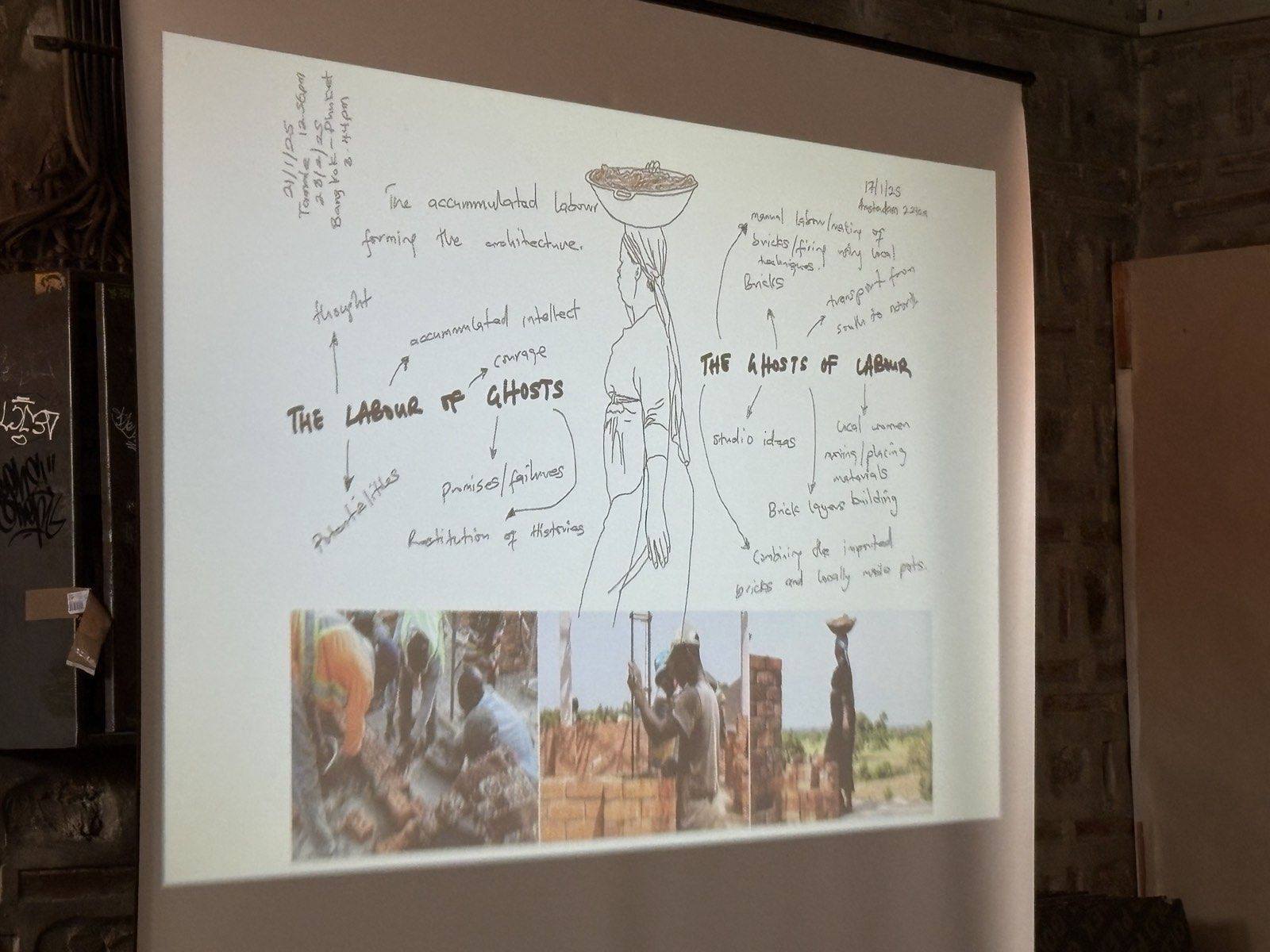
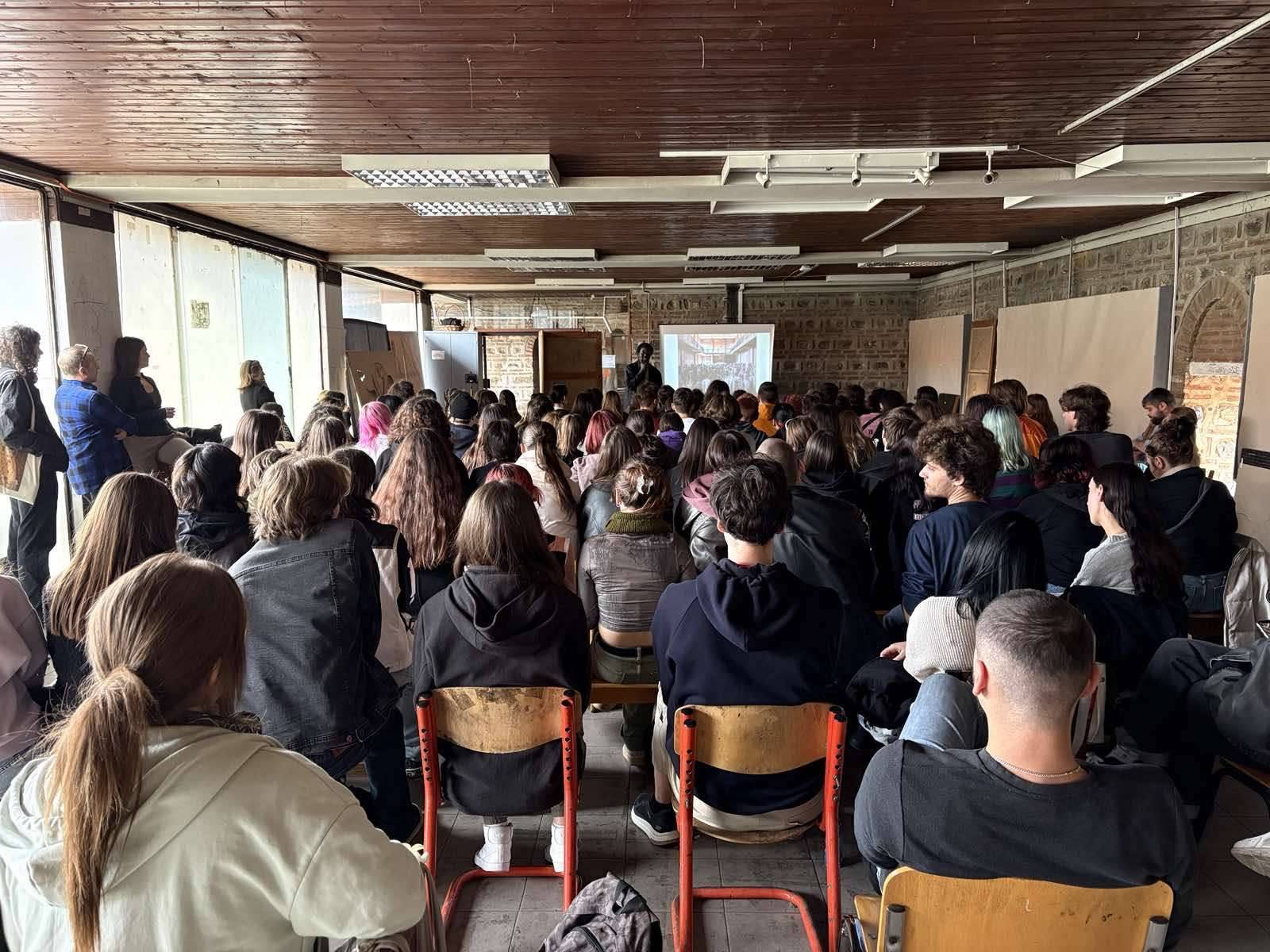
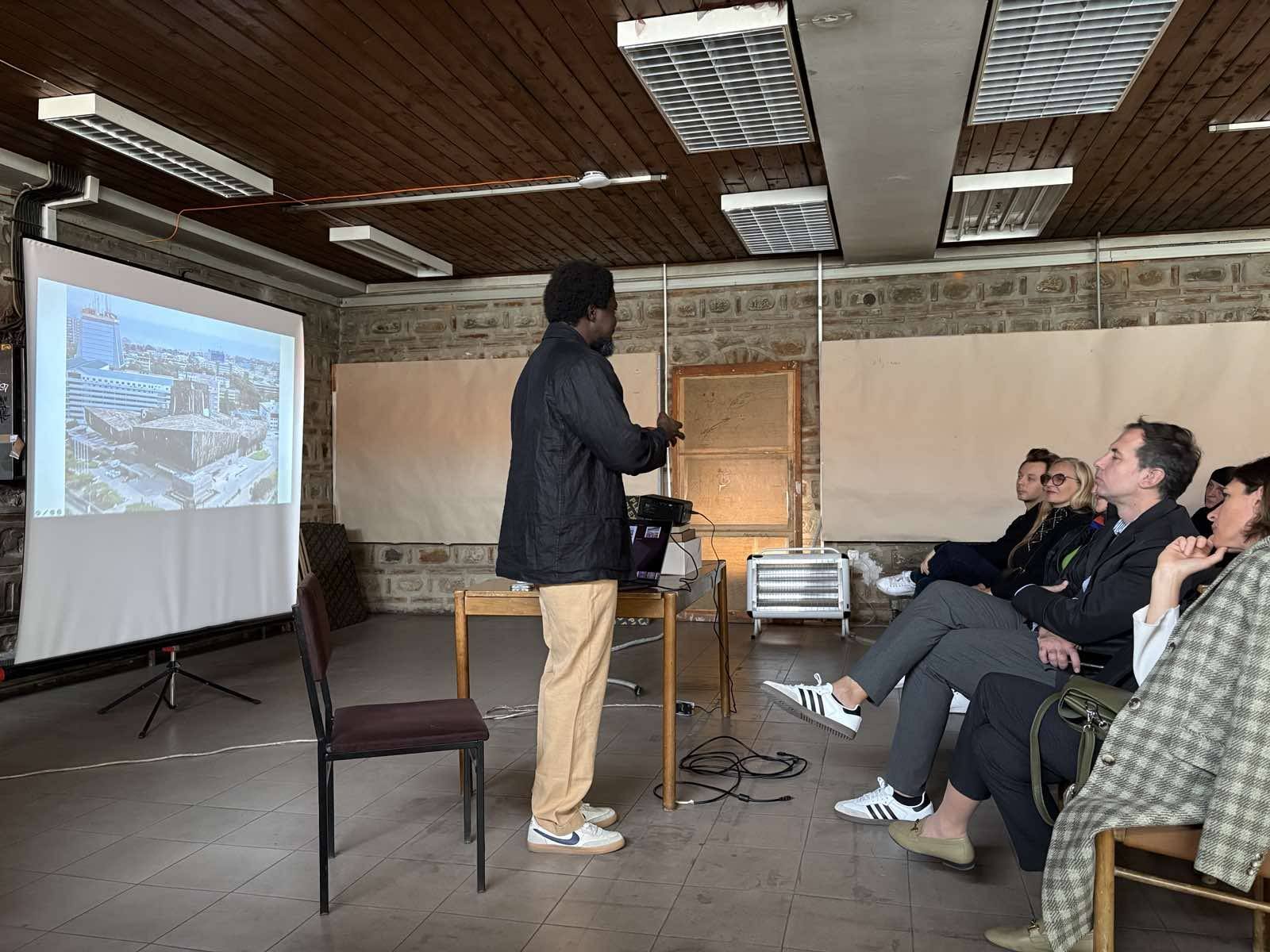
In collaboration with the Faculty of Arts – Skopje, and on the occasion of the solo exhibition of Ibrahim Mahama at the Museum of Contemporary Art – Skopje, the lecture and artist talk by the renowned Ghanaian artist Ibrahim Mahama were followed with great interest and attention. Engaging in an active discussion, students from all study years at the Faculty of Fine Arts, as well as the wider public, had the opportunity to experience a thorough and committed presentation, a well-argued walkthrough of his artistic practice.
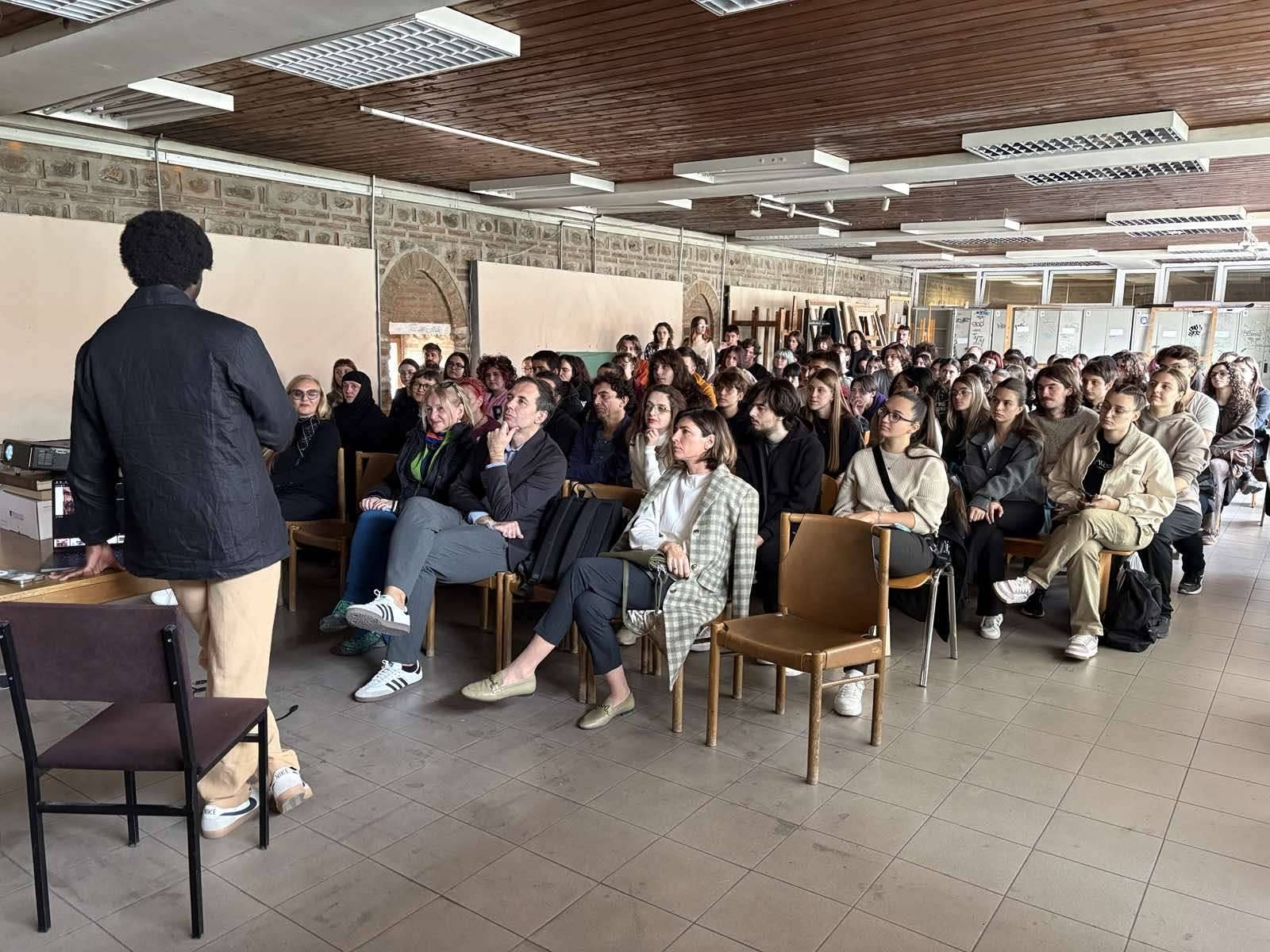
LECTURE: Tomasz Fudala (the Museum of Modern Art in Warsaw)
“The Museum as a New Neighbor in the District”
The lecture will open with a short address by H.E. Mr. Mariusz Brymora, Ambassador of the Republic of Poland to Skopje.
Tomasz Fudala, curator, art and architecture historian , one of the founders of the newly built Museum of Modern Art in Warsaw (MSN Warsaw) – an institution that, after nearly two decades of working in temporary spaces, has finally acquired its permanent building in the city center, at Plac Defilad.
In his lecture, Fudala will speak about the development of the museum as an institution, the architecture of the new building, and its relationship to Warsaw’s urban transformation. He will also discuss the Warsaw Under Construction festival, which MSN has organized since 2009 as a platform for critical reflection on the city, space, and urban planning.
The event is supported by the Embassy of the Republic of Poland in Skopje and is part of the program of the 22nd Biennial of Macedonian Contemporary Architecture.
Images by Maja Wirkus
The 2025 MoCA Skopje Summer Film Programme presents “Is There a Desert in the Middle of the City?”, a film festival that navigates urban landscapes and the ever-shifting terrains of gentrification, (speculative) urbanism, real estate, and the tourist industry in the face of global capitalism. The films explore how such phenomena shape—and scar—cityscapes, rendering cities contested places. The film programme brings together threads that link high-rise construction sites, ever-expanding malls and hotels, fences, scaffolding, paint and cracks in the walls, factories of modernity and their ruins, along with the lives of those affected by and participating in urban change in Beirut, Shanghai, Pernik, Lisbon, Athens, Marseilles, Howrah, and elsewhere.
The selected films refer to the documentary form to different extents. They follow “seismic” gentrification and touristification, but also forms of resistance or survival in cities that are being transformed into vast dormitories for visitors. They tackle impoverishment and precarious work in construction and in tourism, discrimination, displacement, and confinement. They closely examine the aesthetics and materiality of the phenomena they record, through sound, cityscapes, and found material. Alongside the processes and politics of remembering and forgetting in public spaces, the films also touch on interrupted, often intimate, memories of other places, times, and people. What are the everyday realities beneath the rhetoric of progress, comfort, and expansion? How does global capitalism build—and unbuild—the cities we inhabit? How does it reshape urban landscapes, labor, and everyday life?
Curator: Sofia Grigoriadou
Thursday, 10/07/2025, 20:30 – 21:40
SHANGHAI, ATHENS, LISBON

Shanghai
Passage • director Di Hu • China • 2016 • 11 min
This film depicts architectural and urban research of a specific area in Shanghai. The bridge you see in this film was renovated before the Shanghai World Expo in 2010. It is a flimsy copy of the Alexandre III bridge, beside which is the Carrefour supermarket which was already decorated a few years before with a gigantic mural of Parisian life scenes and occupied the location of the Grand Palais. The reason why I chose to film this area is that it strongly resembles the Grand Palais area in Paris. From an emotional standpoint, I have a deep attachment to both cities, having lived in both for many years. On the more practical side, I have made this film to express my concerns regarding the mindless globalisation of Shanghai, which has transformed the city into a science-fiction-like landscape through the blending of socialist and hypermodern elements.
Di Hu is an artist-researcher based in Dublin and Shanghai. His work across film, video and photography investigates the legacy of the cinema through interpretation of forms, codes and narratives of films. His artistic practice also examines the effects of the dominance of technology in society.

Athens
Sleeping City • director Dimitra Kondylatou • Greece • 2023 • 10 min
A fictional short story about a city turning into a dormitory: everyday activities disappear in this city, where the visitors (sleepers) arrive to sleep, and the inhabitants stay awake, in order to work in the dormitory. When, for various reasons, everyone loses their sleep, emerges confusion about the city’s function and identity. The visual narrative of the video consists of images, relevant to the rapid expansion of the tourist activity in Athens: the documentation of façades in the city center, and of buildings turning into hotels, archival material from the Hellenic Literary & Historical Archive (E.L.I.A.), advertising spots of the National Tourism Organization (E.O.T.), articles, and video performances.
Dimitra Kondylatou lives in Athens. She works across video-making, editing, writing, and hosting. She is interested in the limits of art and its entanglements with tourism and everyday life. Her methodology is informed and crosses boundaries with other disciplines, through her participation in art residencies and collective projects, and the presentation of her work in festivals, exhibitions, conferences and publications.

Lisbon
Terramotourism • Left Hand Rotation • Portugal • 2016 • 43 min
Directed and produced by Left Hand Rotation collective, Terramotourism is a subjective portrait of a city and its transformation during the last 6 years. On 1 November 1755 an earthquake destroyed the city of Lisbon. Its impact was such that it displaced man from the center of creation. Its ruins legitimized Enlightened Despotism. Lisbon today is trembling again, shaken by a tourist earthquake that transforms the city at cruising speed. Its impact displaces the inhabitant of the center of the city. What new absolutisms will find their alibi here? As the right to the city collapses, drowned by the discourse of identity and the authentic, the city creaks announcing the collapse and the urgency of a new way of looking at us, of reacting to a transformation, this time predictable, that the despair of Capitalism pretends inevitable.
Left Hand Rotation is an artistic collective active since 2005 that develops projects that articulate intervention, appropriation, recording and video manipulation. Each action of the collective has a strong awareness of the importance of the audiovisual record, both for its value as raw capture, and for the potential of each video clip to become language units whose combination and manipulation enables the transmission of complex messages based on daily details.
Tuesday, 15/07/2025, 20:30 – 22:30
MARSEILLES, BEIRUT

Marseilles
In the Middle of the City There Was the Desert • directors Joachim Gatti & Gaël Marsaud • France • 2019 • 13 min
A film that brings together a short story by Elio Vittorini, published in 1941, and the daily life of La Plaine, a neighborhood in Marseille undergoing reconstruction. Erected by the city council to prevent any occupation, a huge wall cuts the neighborhood off from its heart and besieges it from within. At the foot of the wall, the words of the Italian poet and resistance fighter find a new and strange resonance.
Joachim Gatti is an artist whose practice combines documentary experience, militant investigation and collective creation. He develops projects anchored in specific contexts – neighborhoods, gardens, health centers, etc. His work takes many forms: video, radio, writing, woodcuts.
Gaël Marsaud, a political scientist and filmmaker, explores the intersections between art and politics. His films, often set in rapidly changing urban contexts such as Marseille and Santiago, examine civic mobilizations, transformations of public spaces, and the challenges of preserving memory.

Beirut
Taste of Cement • director Ziad Kalthoum • Syria, United Arab Emirates, Germany, Lebanon, Qatar • 2017 • 85 min
In Beirut, Syrian construction workers are building a skyscraper while at the same time their own houses at home are being shelled. The Lebanese war is over but the Syrian one still rages on. The workers are locked in the building site. They are not allowed to leave it after 7 p.m. The Lebanese government has imposed night-time curfews on the refugees. The only contact with the outside world for these Syrian workers is the hole through which they climb out in the morning to begin a new day of work. Cut off from their homeland, they gather at night around a small TV set to get the news from Syria. Tormented by anguish and anxiety, while suffering the deprivation of the most basic human and workers rights, they keep hoping for a different life. Winner of the Golden Sesterce for Best Feature Documentary at Visions du Réel 2017 and nominated to the German Academy Awards 2018.
Ziad Kalthoum is a Syrian filmmaker, scriptwriter and film consultant currently living in Berlin. In 2012, he began working on his first feature film “The Immortal Sergeant” (premiered at the Locarno Film Festival, 2014) while serving a compulsory military service. Refusing to fight his own people, he deserted from the Syrian Army in 2013 and fled to Beirut where he started to work on “Taste of Cement”. He is currently working on his feature film, “Last Trip”.
Thursday, 17/07/2025, 20:30 – 11:00
NEW YORK, HOWRAH, PERNIK

The Factory Gates
Workers Leaving the Factory • director Harun Farocki • 1995 • 36 min
Workers Leaving the Factory – such was the title of the first cinema film ever shown in public. For 45 seconds, this still existent sequence depicts workers at the photographic products factory in Lyon owned by the brothers Louis and Auguste Lumière hurrying, closely packed, out of the shadows of the factory gates and into the afternoon sun. Only here, in departing, are the workers visible as a social group. But where are they going? To a meeting? To the barricades? Or simply home? These questions have preoccupied generations of documentary filmmakers. For the space before the factory gates has always been the scene of social conflicts. And furthermore, this sequence has become an icon of the narrative medium in the history of the cinema. In his documentary essay of the same title, Harun Farocki explores this scene right through the history of film. The result of this effort is a fascinating cinematographic analysis in the medium of cinematography itself, ranging in scope from Chaplin’s Modern Times to Fritz Lang’s Metropolis to Pier Paolo Pasolini’s Accattone!. Farocki’s film shows that the Lumière brothers’ sequence already carries within itself the germ of a foreseeable social development: the eventual disappearance of this form of industrial labor (Klaus Gronenborn).
Harun Farocki (1944-2014) was a German filmmaker and lecturer in film, author of over 90 films, productions and numerous installations. He was writer and editor of the magazine Filmkritik, Munich. His work has been exhibited at the Carnegie International, Carnegie Museum of Art; documenta 12, Kassel; the Tate Modern; the Museum of Modern Art, New York City; and elsewhere.
The film is kindly offered by the Goethe-Institut Skopje

New York, Howrah
Cast in India • director Natasha Raheja • India, USA • 2014 • 26 min
Iconic and ubiquitous, thousands of manhole covers dot the streets of New York City. Enlivening the everyday objects around us, this short film is a glimpse of the working lives of the men behind the manhole covers in NewYork City. In Cast in India, Natasha Raheja raises questions around the disparate conditions that shape the geographies of production of everyday urban objects. How does the built infrastructure of New York City conceal the labor infrastructure on which it stands?
Natasha Raheja is a Brooklyn-based filmmaker. She is currently pursuing a PhD in Sociocultural Anthropology at New York University with a Certificate in Culture and Media. Her research interests are in the areas of migration, material flows, and belonging.

Pernik
Cracks • director Dimitra Kofti • Germany • 2018 • 55 min
Shiny supermarkets stand next to dilapidated factory buildings in the Bulgarian city of Pernik, one of the Balkans once most important industrial areas. The film explores daily life experiences and memories in a city marked by a history of industrialization and deindustrialization, where multiple epochs and teleologies of modernity coexist. People’s lives are filtered by Pernik’s industrial rise and decline and by the shift from the socialist to the post-socialist era. The narrative focuses on people’s working lives, through which stories unfold: current work practices, memories from the abandoned factories, migration stories, narratives about precarity, strikes, daily coping strategies. The ‘cracks’ are apparent in the urban landscapes and in the narratives. They are employed in the film as metaphors that underline the meeting points of multiple temporalities; cracks inscribe changes and epochs while they also connect them.
Dimitra Kofti is an anthropologist interested in work, precarity, shifting temporalities, and film. She has conducted research on changing work relations, in the context of flexibilisation of labour in post-socialist Bulgaria. She is an assistant professor at the Department of Anthropology, Panteion University of Social and Political Science (Athens, Greece).
The Museum of Contemporary Art Skopje is grateful for the help in the realisation of the program to the Goethe-Institut Skopje, Delphine Leccas, Videoart Miden, Zhivko Grozdanoski
Within the MSU Skopje Interdisciplinary program, academic Vlada Urošević MSU-Skopje will have a lecture titled “An Exhibition: Fantastic Art, Dada, Surrealism, MoMA, New York, 1936-37” on April 29 (Tuesday), at 7 p.m.
Vlada Urošević is a member of the Macedonian Academy of Sciencies and Arts and professor (retired) at the “Blaže Koneski” Faculty of Philology. In addition to his literary work, he has published: “Miracles and Monsters – on Fantasy in Painting” (2001) and “Invented Worlds – on Surrealism in Painting” (2003). Together with Lidija Kapuševska-Drakulevska, in 2023 he published the book “Birds in an Aquarium: Surrealism 1924 – 2024”, awarded with the Dimitar Mitrev Award of the Macedonian Writers Association. He had two exhibitions at the MANU Art Gallery (in 2013 and 2025) in which he exhibited digital collages.
The interdisciplinary program of the Museum of Contemporary Art Skopje, announces the International Symposium The Earth is Thinking All Along, starting on Monday, June 10 2024 at 10:00 AM
The liquid grounds, the frozen mountaintops, the concrete jungles and the deepest ocean troggs, the earth consists of infinite series of local and translocal systems that somehow ‘act as one’, not just by being material assemblages but also in how these systems search to persevere in being, in how they understand, learn and respond to what they encounter. In modern times, the dominant narrative told us that only humans were able to “think properly” and that the more-than-human world was there to serve those humans. Also, these humans were white, European, obviously male, and “well educated”. The current era challenges these notions profoundly. The wounds of ongoing forms of (racial) settler capitalism, are more and more speaking up, through fellow human beings, flora and fauna, but also through the environmental crises that more and more prove its short-sightedness, and failure.
Whether we asked for it or not, art has always been addressing the patterns of perception, by means of which we tend to inform ourselves. It does not so much ‘give a voice to the unheard’, as activists like to claim, but rather reveals this other earth, that many of us couldn’t or wouldn’t see. Playing the sensuous differently, the arts have been immensely important, especially in our time, in questioning and changing our ideas of the earth, the ‘lives’ it gives rise to, and its options for survival.
As all of us are facing these crises of the ecological contemporary, feel the potential force of the upcoming changes, and the existential threat that it is, we all need art, and art of the highest kind, as Deleuze and Guattari said, to become our toolkit for survival. And thus, as a modest opening bid, to start exploring the earth and the infinity of ideas, it can generate, this exhibition couples groundbreaking artists to groundbreaking philosophers from all over the globe, all of them intrigued by our contemporary more-than-human complexities, to jointly imagine this world otherwise.
Joining forces, the philosopher and the artist experiment, map, and speculate on the earth, situating themselves in the land and the water, finding out in what way art and philosophy are able to take up responsibility for the earth together. We visit the delta cities threatened by the rising sea levels, the swamps and their long histories of life and death, the islands of the pacific and their wholly other forms of life and the sheer endless tundra far away from the salty waters. Not aiming at creating an overview, The Earth is Thinking All Along… offers a bundle of entry points for rethinking the earth, for launching a new “philosophy of land”. An affirmative joint action of artists and philosophers who joyfully propose to change our lives together.
Program
10.00 Welcome and Introduction
10.30 A. Position Papers Session 1
(10-minute presentation, 10-minute discussion)
11.50- 12.10 Coffee Break
12.10 B. Position Papers Session 2
(10-minute presentation, 10-minute discussion)
13.10 C. Student presentation: Sonic Reflections on the Anthropocene
(Utrecht University in collaboration with several institutes from Skopje)
13.30-14.30 Lunch
14.30 D. Transversal Concepts
(5-minute presentation, plus short discussion):
14.30 Transversal Concepts (5 minute introduction, 10 minute discussion)
14.30 Mutation – Christian Alonso
14.45 Embodied/Enfleshed – Kristiina Koskentola
15.00 Transcoding – Rick Dolphijn
15.15 Landscape – Tihomir Topuzovski
15.30 Weak Technology – Alex Taek-Gwang Lee
15.45 Sense of Care – Irena Chawrilska
16.00 ‘Solidaritude’ (solidarity and solitude) – Toshiya Ueno
16.00- 16.20 Coffee Break
16.20-18.00 E. Towards an Exhibition
19.00 Dinner in town
Abstracts
Christian Alonso
This presentation analyzes the work of artists Ferran Lega, Sissel Marie Tonn, Guiu Gimeno Bardis and Marco Noris through the guattarian concept of mutation. The projects explore the sociobiotechnical inscriptions of thyme, the pothuman transversality of plastic, the political potential of queer subjectivities in the rural environment, and the density of stories, memories and experiences that rivers encapsulate. The chosen projects were part of group exhibitions about multispecies communities, the affective power of sound, queer ecologies, and hydrofeminism, produced by the La Panera Art Center (Lleida, Catalonia, Spain). By resorting to critical perspectives, situated methodologies, rigorous research and collaborations with local actors, the works not only manage to map transformations (of landscapes, bodies, materialities, signs) but also instigate a myriad of transformations.
Transversal concept: Mutation
Kristiina Koskentola
I will be working with taiga and her forests, mountains, lakes, rivers and ice from Lake Saimaa in Karelia (Finnish side) to Amur River in Manchuria (Northeast China). Whilst the project brings us to two opposite ends of the Russian federation, alongside with other colonized territories, to emphasize the limits (and failure) of human-centred knowledge and agency the inherent human geopolitics are approached via animistic positions and more-than-human knowledge. I collaborate with Manchu shamanic composer and musician Han Xiaohan. The project will manifest in collaborative, polyvocal 3 channel spatial video installation (each with a separate sound), possibly an entangled installation of objects, written essay/ material for the publication, and a performative concert by Han Xiaohan, the last as a part of the possible public program during the exhibition.
Transversal Concept: Embodied/Enfleshed
Rick Dolphijn
In ancient Egypt, the people did not live ‘in a country’. Everybody lived the Black Earth (Kemet), the new rich wetland that, after the flood, could feed them, their companions, their environments. The Nile River (Ar or Aur, which also means ‘black’) included the rains that fell from the sky, whereas the earth also included the sediments that flowed in the river, and that troubled it. So, rather than isolating elements of the ecosphere, the blackness they referred to, should better be seen as ‘the one darkness, that flows’, through land, water and air.
‘The one darkness, that flows’, never just concerned the Nile River and its delta. Its dark and connective forces create all the deltas in which we live, makes them fertile, and gives rise to its cycles of life. Can we map how different forms of life are occupying these flows creatively, artistically, and play with it? And what are these artists teaching us on how we need to understand the flow anew?
Transversal Concept: transcoding
Tihomir Topuzovski
The paper has two primary goals, the first is to understand the anthropocentric liquid landscapes and its overlapping with geopolitical and other ideological surroundings, and the second is what shape this art does and ought to take today in order to address these landscapes, to create a sort of new ethical horizon of engagements, and open up a space for reimaging the human relations at play within a broader nexus of inter and extra human relations.
The paper provides some empirical background by examining various liquid landscapes in Macedonia such as tailings piles, rivers and lakes.
Transversal concept: Landscape
Alex Taek-Gwang Lee (Kyung Hee University, South Korea)
In this presentation, I will reframe the concept of the Earth by revisiting the Russian avant-garde artist Kazimir Malevich’s notion of The Non-Objective World. Through his Suprematist art, Malevich’s non-objective world sought to transcend the representation of physical objects and the material realm. Instead, it focused on pure abstraction, employing geometric shapes and a limited color palette to evoke a sense of universal, spiritual experience. Malevich’s aim was to strip away the distractions of the physical world to reveal a more profound, essential reality. I will relate this discussion to Gilles Deleuze and Félix Guattari’s conception of creating a new Earth, as developed in their influential work A Thousand Plateaus. As Deleuze and Guattari elucidate, the Earth is not merely another force among many, nor is it a substance endowed with form, nor a coded milieu with bounded domains and apportioned shares. Rather, the Earth has become the intimate embrace of all forces, those intrinsic to the Earth itself as well as those of other substances. By juxtaposing Malevich’s non-objective world with Deleuze and Guattari’s conceptualization of the Earth, I will explore the notion of transcending the physical and material realms to access a deeper, more essential reality – a reality that emerges from the coalescence of all forces.
Transversal Concept: Weak Technology
Irena Chawrilska
As we are thrown into shifting assemblages that constantly remake us and the land we are connected to, we remain in flux. Assembling unpredictable encounters and mixed beings, we are not stable in the world – metaphorically, we are on the swamp – as we are today in the looming climate crisis. Not only are glaciers melting and certain birds and species are disappearing in Amazonia, the world beneath our feet is changing everywhere. Wetlands: marshes, bogs, swamps, fens, mangroves and meadows are vessels for our imagination. We associate them with living things, with inexorable movement, with the phenomenon on the border between life and death, a hybrid of water and land that frightens us. How do we retell the stories of the swamp, connecting past and future with art, technology, folk tales and local culture? Re-seeing, re-hearing, re-feeling, re-understanding swamps, re-asking epistemological questions, can be the way to re-entangle with the swampland.
Transversal concept: Sense Of Care
Toshiya Ueno
This paper has traced back a genealogy of conceptions and imaginations on floating sites and sunk lands in the Japanese post-war novels, films, and subcultures on the on hand, while it presents and articulates their counter-partial or contemporary initiatives in photography, arts, films, projects in visual cultures on the other. It would clarify how our ongoing crises of climate change and potential nuclear disaster can speculatively be analyzed through archipelagic ontology.
Archipelago is not simply about islands. In this presentation, continents or lands, along with biological cells, astronomical entities, cityscapes, would be envisioned in archipelagic formation of the world.
Transversal concept: ‘solidaritude’ (solidarity and solitude)

