

27/11/2025 - 01/03/2026
The exhibition All That We Have in Common: An Institution That Breathes introduces the theoretical and political foundations of “combat breathing” as a critical method for acting and reading air as a political medium within the institutional sphere.
Breathing the same air does not mean that we breathe equally. The lack of breath usually follows the lives of the marginalized. Frantz Fanon describes the dreams of the colonized body as “muscular dreams: dreams of action, dreams of aggressive vitality, of combat breathing.” In these dreams of freedom, the lungs are both instrument and muscle, sometimes atrophied by the toxicity of colonial atmospheres, but always ready to take a sudden breath in decolonial efforts.
In a time when systematic abuse suffocates the disenfranchised and catastrophic governmental or corporate practices take away the breath of the underprivileged, the challenge is to breathe deeply and fully. We inhale when it is hard and exhale when we are freed from a heavy burden, with the intention of showing the world what happens when people are excluded, deprived of rights, and oppressed.
Inspired by the notion of “combat breathing” and the widespread metaphor of being out of breath associated with oppression, the exhibition All That We Have in Common (An Institution That Breathes) shows how artistic practices intervene, visualize, and dismantle the atmospheres of colonialism, imperialism, and capitalism within institutional and everyday life.
Forensic Architecture documents the “toxic clouds” of military and industrial operations that turn the atmosphere into a weapon; in Jumana Manna’s work, air becomes an extension of the territory, colonized and surveilled; Denise Ferreira da Silva and Arjuna Neuman explore the history of colonial extraction and the invisible air as trauma that travels through spaces and bodies; the project Gaza Remains the Story by the Palestinian Museum testifies to the constant suffocation of a territory, politically, physically, and symbolically; Durmish Kjazim’s work reveals the stifled air within exhibitions and archives of institutions where Roma bodies and works remain invisible; Zorica Zafirovska, through her intervention addressing the polluted air in Skopje, opens the local horizon on this theme: breathing as an everyday political act in a city living under constant toxic threat.
All these contexts are interconnected and stem from the same structures of violence: capitalist extraction, colonial hierarchies, and systemic exclusion. The project aims to uncover the violence we pretend not to see, in our environment and cultural spaces, and its material, social, and political configurations. Thus, the most important question is how we can learn to detect the whispers of marginalized apneic bodies and, through artistic practices, think about how to enable them to breathe again.
Artists: Forensic Architecture, Denise Ferreira da Silva and Arjuna Neuman, Durmiš Kjazim, Jumana Manna, Zorica Zafirovska, The Palestinian Museum
Curators: Mira Gakjina and Jovanka Popova
Free download of the catalog: All That We Have in Common: Institution That Breaths
The exhibition is financially supported by the Ministry of Culture and Tourism of the Republic of North Macedonia and Tikveš.
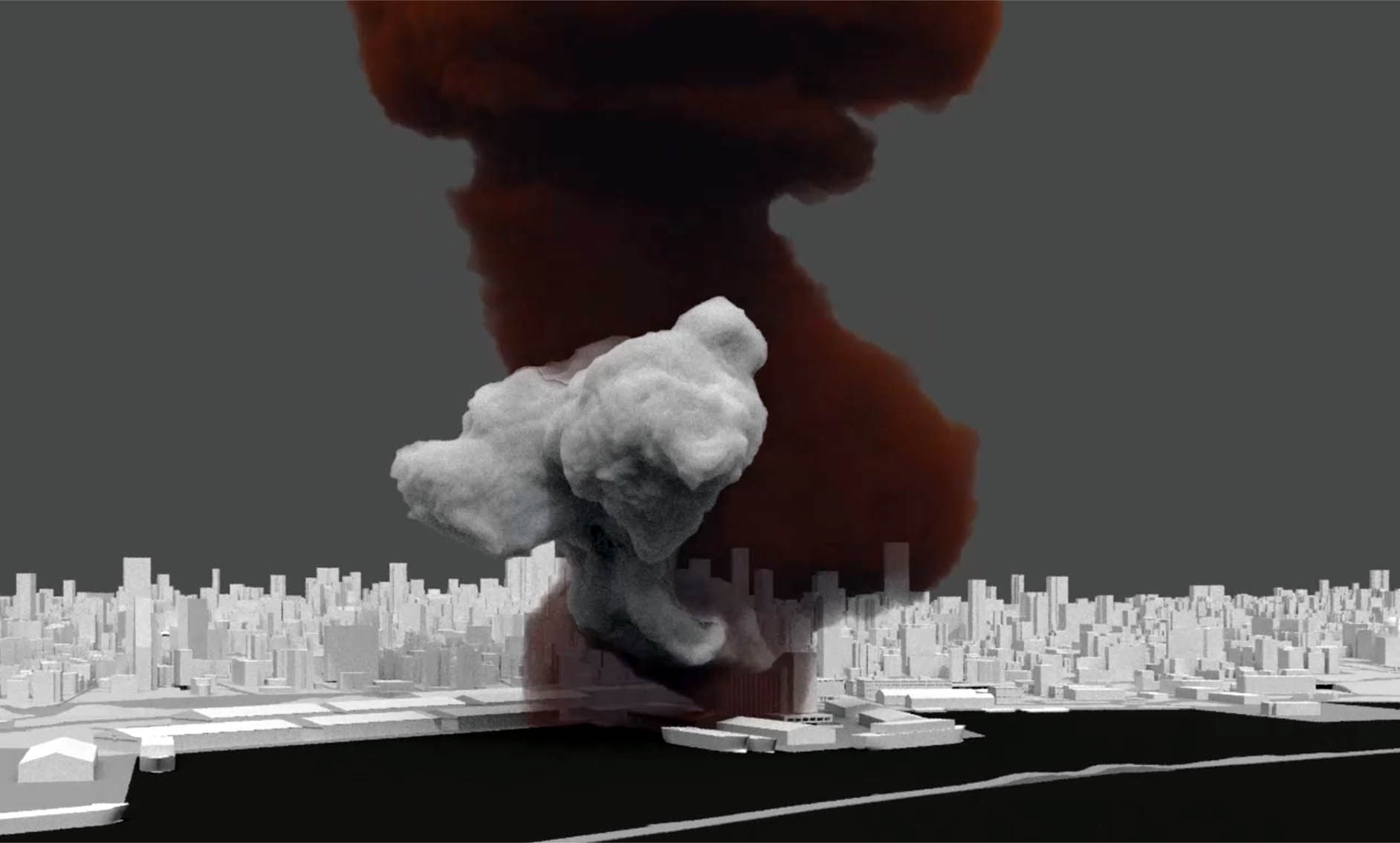
Cover illustration: Forensic Architecture, Cloud Studies, 2020, video, 32’59”
Arjuna Neuman & Denise Ferreira da Silva, Ancestral Clouds Ancestral Claims 2023, video, 49′.
Ancestral clouds Ancestral claims is a film тhat follows the wind and what it carries -from dust to clouds, ideas, stories and voices- as a guide and an analytical framework. Filmed in Chile, in the Atacama desert it explores the entanglements and overlaps of historical events, past present and future, in this site. Taking us on a visual journey through the ALMA large array facility, an international astronomical observatory, and the lithium mines of the Atacama, the film shows how material trajectories are deeply entwined with the pursuit of foundational ideas from the enlightenment, their mutation into aspects of modern neoliberal authoritarianism and their dissemination. Timeless, plural, and untamable, the wind in virtue of the memories, particles, and ancestral claims it carries, acts as a prism that reveals that which is hidden in plain sight: the pillars of Western thought that sustain colonial legacies of inequality, racial exclusion and human extractivism. The film is shown as an immersive video installation. The installation will extend the ideas on wind and clouds and include a “cloud chamber” filled with vapour and the research archive of the work.

Forensic Architecture, Cloud Studies, 2020, 32’59’.
From Palestine to Beirut, London to Indonesia and the US–Mexico border, Forensic Architecture investigate, explore and expose how power reshapes the very air we breathe. Tear gas clouds spread poison where we gather, bomb clouds vaporise buildings, chemical weapons suffocate entire neighbourhoods and air pollution targets the marginalised. Our air is weaponised. Our clouds are toxic. Cloud Studies includes the first phase of a major Forensic Architecture investigation on environmental racism along the banks of the Mississippi in Louisiana. Here, majority-Black communities whose ancestors were enslaved on these grounds breathe the most toxic air in the US – leading to the region’s nickname, ‘Cancer Alley’.
Installation view. In the front, Zorica Zafirovska, Institutional Gardens, 2025, installation, video, olive tree and seed balls for sharing. In the background, Forensic Architecture, Cloud Studies, video screening.
Zorica Zafirovska’s builds a long-term project that includes small actions, workshops, and activities in collaboration with students and teachers from Kole Nedelkovski Elementary School, members of the Green Ark and the Bostanie community garden, biologist and ecologist Kiril Arsovski, gardener Andrej Rajatovski, and employes of the Museum of Contemporary Art – Skopje, volunteers and passersby. The Institutional Gardens project explores the possibilities of ecology as a space of shared responsibility, care and empathy. In the context of contemporary society, ecology is no longer understood only as a science or activism, but as a way of life and cooperation, connecting cultural, social and political processes of everyday life. The project emphasizes the need to rethink institutions as living ecosystems – open, flexible, responsive and sustainable. In a time of accelerated urbanization, climate crises, and growing fragmentation, this project proposes a city as a living organism, where every public space can become a garden—a place of renewal, learning, and togetherness.

Installation view. In the front, Zorica Zafirovska, Institutional Gardens, 2025, installation, video, olive tree and seed balls for sharing. In the background, Palestinian Museum, Gaza Remains the Story, digital collection of materials from the Museum of Contemporary Art – Palestine.

Zorica Zafirovska, Seed balls – take one, plant it, create life! 2025, installation with seed balls.
Each visitor will have the opportunity to pick up seed balls, small ecological capsules made up of soil, seeds and natural fertilizer, ready to give birth to a new plant without much effort. It is enough to plant them in your garden, on a balcony, or simply throw them into nature in a place that needs more greenery.
Take a seed ball and let nature continue to grow!

Jumana Manna, Foragers, 2022, video, 63’24”.
Foragers depicts the dramas around the practice of foraging for wild edible plants in Palestine/Israel with wry humor and a meditative pace. Shot in the Golan Heights, the Galilee and Jerusalem, it employs fiction, documentary and archival footage to portray the impact of Israeli nature protection laws on these customs. The restrictions prohibit the collection of the artichoke-like ’akkoub and za’atar (thyme), and have resulted in fines and trials for hundreds caught collecting these native plants. For Palestinians, these laws constitute an ecological veil for legislation that further disposses them from their land while the occupation’s state representatives insist on their scientific expertise and duty to protect. Following the plants from the wild to the kitchen, from the chases between the foragers and the nature patrol, to courtroom defenses, Foragers captures the joy and knowledge embodied in these traditions alongside their resilience to the prohibitive law. By reframing the terms and constraints of preservation, the film raises questions around the politics of extinction, namely who determines what is made extinct and what gets to live on.

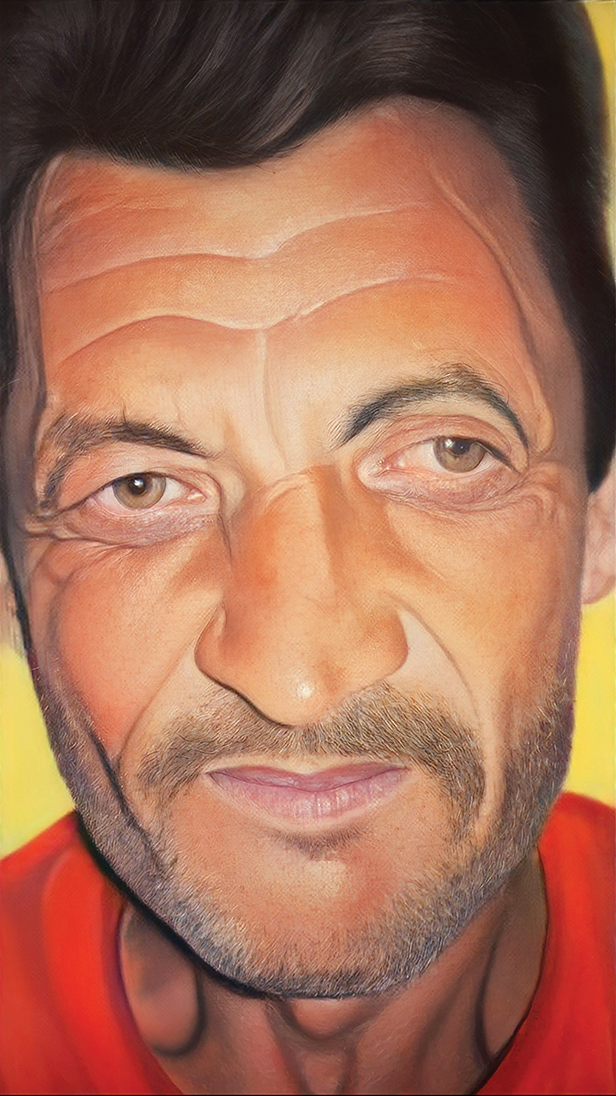
Durmish Kjazim, Portrait of a Roma Man, 2016, soft pastel on paper.
Through the subtle precision of pastel drawing, Kjazim brings attention to the questions of visibility and representation of Roma people within public and institutional spaces. The portrait, a gift from the artist and part of the collection of the Museum of Contemporary Art – Skopje, positions the image of a Roma man in a context where it has rarely, if ever, been present — within the institutional framework of art. In doing so, the work not only portrays a face but also inscribes a presence, opening space for rethinking representation and the position of marginalized subjects within contemporary society.
Arjuna Neuman and Denise Ferreira Da Silva, Ancestral Clouds Ancestral Claims, 2023, video, 49′.

Palestinian Museum, Gaza Remains the Story, 2025, series of posters.
“Gaza Remains a Story” presents the cause and context of the Palestinian experience. The exhibition seeks to inform, educate and tell stories about historical sites and cultural practices in Gaza, providing insight into the art, aspirations and uniqueness of Gaza – what remains of it in these harsh times.
While the deafening noise of the endless bombardment drowns out the daily life, heritage, artistic expression and creativity of the people of Palestine, this exhibition seeks to look behind the curtains of the theatre of war and conquest. By telling the stories of Gaza and countering disinformation, “Gaza Remains a Story” aims to provide a global audience with information and references to contextualise Gaza within Palestine, the region and the world. This exhibition uses audiovisual material to explore the historical, economic, geographical, demographic and creative aspects of life in Gaza.

Palestinian Museum, Gaza Remains the Story, 2020.
Digital collection of materials from the Museum of Contemporary Art-Palestina.

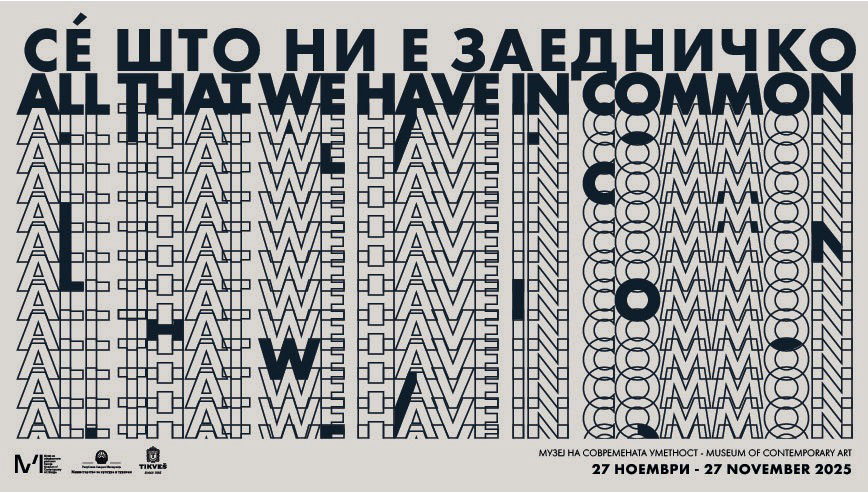
Visual identity for the exhibition, designed by Albana Bektesh
INTERRUPTION IN PROGRESS
29/07/2026 - 20/08/2026
ANARCHIC BODIES: Consent Not To Be A Single Being
30/05/2026 - 21/08/2026
Touch Nature
04/12/2025 - 14/02/2026

Masterpieces for Everyone: Museum in a Suitcase
24/11/2025

